
If a site has no mains power - or a power outage means a life-safety risk - the pump must bring its own power. Diesel-driven water pumps are the workhorse of off-grid water supply: they start independently, deliver full rated flow, and run for hours without the grid.
1. When diesel drive makes sense
- Off-grid sites - farms, mining camps, island communities, remote construction sites;
- Emergency / disaster response - mobile water delivery after storms or grid failure;
- Fire protection - a diesel fire pump is the standard back-up (or primary) source where grid reliability is questionable;
- Mobile and temporary duty - irrigation during the season, dewatering on projects, then relocated elsewhere.
2. Diesel vs electric: the trade-off
| Factor | Electric drive | Diesel drive |
|---|---|---|
| Availability | Needs reliable mains or generator power | Runs anywhere - fuel is the only input |
| Operating cost | Lower where power is cheap | Higher fuel cost, but independent |
| Start-up | Instant, remote-start possible | Auto-start on pressure drop (panel-controlled); needs battery & fuel care |
| Maintenance | Simple motor service | Engine service: oil, filters, fuel, battery |
| Typical duty | Continuous, clean, indoor | Emergency, mobile, remote, fire |
3. Typical diesel pump set configuration
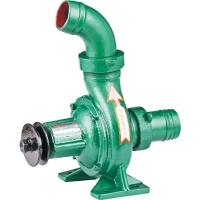
A complete set from Ocean Pumps combines an XA end-suction centrifugal pump with a diesel engine through an elastic coupling, mounted on a common skid:
- Pump: XA end-suction (motor/engine driven by design; packing or mechanical seal);
- Engine: reliable water-cooled diesel, sized with 15–20% power margin over the pump's shaft power at duty point;
- Control panel: auto/manual - starts on pressure drop, stops on recovery; low-oil and high-temperature engine protection;
- Accessories: fuel tank, battery, gauge panel, discharge manifold - all pre-assembled and factory run-tested.
4. Sizing and suction notes
- Size the engine by the pump power at the worst duty point (highest flow), not the nameplate average;
- Keep suction lift within limits (~6–7.5 m at sea level) - or use flooded suction / a vacuum priming system for large sets;
- Specify tropical/filtered air intake and heavy-duty fuel filtration for dusty or remote sites;
- Confirm export packing - moisture-proof, sea-worthy crating for container shipment.